
These maple mustard pork meatballs bring a sweet, tangy glaze to a Christmas dinner platter without repeating the site’s pork tenderloin recipe. They are baked first, then tossed in a short stovetop sauce made with real maple syrup and whole-grain mustard. The batch makes twenty-four meatballs, or six dinner portions of four.
Table of Contents
Why maple mustard pork meatballs work
Pork has enough richness to stand up to mustard and vinegar. Maple syrup softens the sharp edge of the sauce without needing a long reduction. The meatballs cook separately, which makes it easier to check their temperature and leave rendered fat on the tray before adding the glaze.
A little soaked breadcrumb mixture and an egg help the portions hold together. The meatballs do not need a heavy breading or a frying step. They can be served as a dinner main or divided into smaller appetizer portions, but the nutrition panel uses six dinner servings. Changing the serving count changes the numbers for each plate.
Pork, maple syrup and mustard choices
Use raw ground pork and check the package when calculating your own nutrition. Regular ground pork is used for this estimate and can be fairly high in fat. Extra-lean pork, a pork-and-turkey blend or sausage will all change the texture and macros. Seasoned breakfast sausage also brings extra salt and spices, so it is not a direct swap.
Pure maple syrup gives the sauce its maple flavor. Pancake syrup and sugar-free syrup have different ingredients and may thicken differently. Whole-grain Dijon mustard leaves little seeds in the glaze, matching the illustrated dish. Smooth Dijon can work, but it changes the appearance and may taste sharper depending on the brand. Taste the warm sauce before adding extra mustard.
Baking maple mustard pork meatballs safely
Shape similar-sized portions and keep a little space around each one on the tray. Mix only until combined; kneading the meat for a long time can make it dense. Start checking near the early end of the time range, then continue cooking until several of the largest pieces reach the correct internal temperature.
Ground pork requires 160°F. The 145°F plus rest guidance for whole pork cuts does not apply to a ground-pork meatball. The safe cooking temperature guidance makes that distinction clear. Use a clean utensil to transfer the cooked meatballs to the glaze. Cooking time is a planning estimate, and this recipe has not been kitchen-tested.
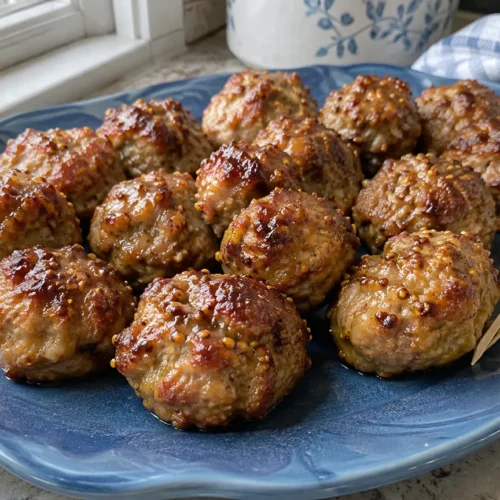
Maple Mustard Pork Meatballs
Ingredients
- 2 lb ground pork raw; generic regular ground pork
- 1 large egg
- 1/2 cup plain dry breadcrumbs
- 1/4 cup 2% milk
- 1 tsp garlic powder
- 1/2 tsp dried thyme
- 1/2 tsp salt
- 1/4 tsp black pepper
- 1/4 cup pure maple syrup
- 1/4 cup whole-grain Dijon mustard
- 2 tbsp apple cider vinegar
- 2 tbsp water
Instructions
- Heat oven to 400°F. Line a rimmed baking sheet with oven-safe parchment. Soak breadcrumbs in milk for 3 minutes in a large bowl.
- Stir egg, garlic powder, thyme, salt and pepper into the crumbs. Gently mix in raw ground pork. Divide into 24 equal meatballs, about 1 1/2 inches across, and arrange with space between them.
- Bake for roughly 18–23 minutes until several large meatballs register 160°F in the center. Ground pork needs 160°F; the lower temperature used for whole pork cuts does not apply.
- Meanwhile simmer maple syrup, mustard, vinegar and water in a saucepan for about 3–5 minutes. Transfer fully cooked meatballs into the hot glaze with a clean utensil. Leave rendered tray fat behind. Toss gently, then divide into 6 portions of 4 meatballs with one-sixth of the glaze.
- Serve promptly or hold at or above 140°F. Refrigerate shallow portions within 2 hours (1 hour above 90°F). Store at 40°F or below for 3–4 days and reheat to 165°F.
Notes
Make-ahead and reheating strategy
Cook the meatballs ahead, cool promptly in shallow containers and refrigerate at 40°F or below. The glaze can be refrigerated separately so it is easy to portion and loosen when reheating. Use cooked pork within three to four days, including the time before a party. Freeze plain cooked meatballs for longer storage and thaw in the refrigerator.
Reheat the meatballs to 165°F before serving again, then toss with the hot glaze. Add a small splash of water if the sauce has become too thick; extra syrup adds calories and sweetness. A slow cooker is useful for holding already-hot meatballs at 140°F or above, but it should not slowly reheat cold leftovers. Our meal-prep guide has more planning tips.
What to serve and how to count portions
Try four meatballs with a smaller portion of roast turkey for a mixed holiday platter, or make pork the only main and add potatoes and green vegetables. The sauce contains sugar from maple syrup, so these are not labeled low-carb. For appetizers, offer smaller portions and explain that the card’s macros use four meatballs.
The calculation counts all pork fat even though some is left on the tray, and all glaze even if a little stays in the pan. It is therefore an estimate of the ingredients, not a laboratory measure of the finished meatballs. See our nutrition-estimate guide. The original featured image is AI-generated, not an owner-taken photograph or a claim of kitchen testing.